Hebel AAC Panels for Residential Construction in Queensland: A Builder's Guide
What Is Hebel?
Hebel is a brand of autoclaved aerated concrete (AAC), a lightweight, precast building panel manufactured by CSR. It's been used in Australian construction for over 30 years and has become increasingly common in South-East Queensland residential construction, particularly for external wall cladding systems.
The most common product for residential cladding is the Hebel PowerPanelXL, a 75mm panel designed for direct application to steel or timber framing.
Why Builders Specify Hebel
Volume builders specify Hebel for a combination of reasons that go beyond the product itself.
Fire resistance: Hebel AAC carries a BAL-FZ (Bushfire Attack Level, Flame Zone) rating, making it suitable for the most extreme bushfire exposure categories. In Queensland, where BAL requirements are increasingly common, this is a significant advantage over standard fibre cement cladding systems.
Termite resistance: AAC is inorganic, termites cannot eat it. In Queensland's high-termite-risk zones, this is a meaningful advantage and can simplify the termite management specification for the whole building.
Thermal performance: Hebel's cellular structure provides genuine thermal mass. In Queensland's climate, this translates to lower cooling loads and better energy efficiency ratings, which matters as NCC energy requirements tighten.
Weight: Despite its structural performance, Hebel is significantly lighter than brick veneer. This reduces structural loads and can simplify footing design on some sites.
Speed of installation: An experienced Hebel installation crew can cover significant wall area per day. On a volume programme, this speed advantage compounds across a development.
The Installation Process
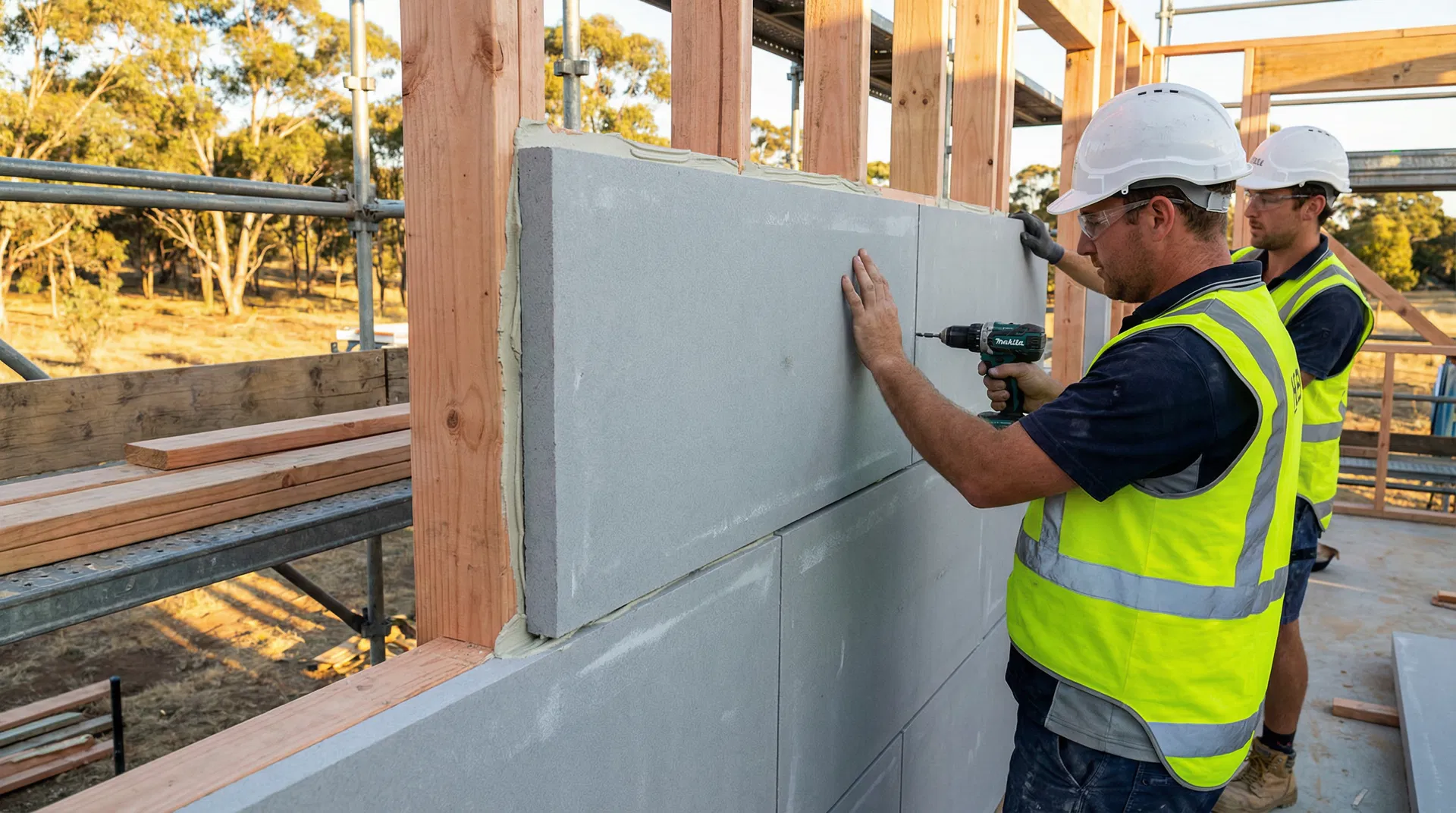
Hebel installation is a specialist trade. The panels are large and heavy, requiring appropriate handling equipment. The fixing system, adhesive and mechanical fixings to the framing, must be installed to CSR's specification to maintain the system's structural and fire ratings.
The process follows a defined sequence:
- Frame inspection, the framing must be within tolerance before panels are installed
- Panel layout, panels are set out to minimise cuts and waste
- Adhesive application, CSR-specified adhesive is applied to the framing
- Panel installation, panels are fixed with adhesive and mechanical fixings
- Joint treatment, panel joints are filled and reinforced
- Render application, the system is completed with an approved render system
The render system applied over Hebel must be compatible with the AAC substrate. Render King uses Dulux Acratex systems specified for AAC substrates, ensuring the render and panel system work together as designed.
Hebel vs EPS Cladding
Both Hebel and EPS (expanded polystyrene) cladding systems are common in South-East Queensland volume residential construction. The right choice depends on the project specification.
| Factor | Hebel AAC | EPS Cladding |
|---|---|---|
| , | , | , |
| Fire rating | BAL-FZ capable | BAL-12.5 to BAL-29 (system dependent) |
| Termite resistance | Full | Full (EPS is inorganic) |
| Thermal mass | High | Low (insulation, not mass) |
| Weight | Moderate | Very light |
| Cost | Higher | Lower |
| Speed | Fast | Very fast |
For projects with BAL-FZ requirements or where thermal mass is a design priority, Hebel is the right choice. For standard residential construction where cost and speed are the primary drivers, EPS cladding systems are a strong option.
Working With Render King on Hebel Projects
Render King supplies and installs Hebel PowerPanelXL for residential and low-rise construction across South-East Queensland. Our crews are trained in CSR's installation specification and we manage the full process from supply through to render completion.